

The Science Behind Binaural Beats: Fact vs. Fiction
Table of Contents
1. What Are Binaural Beats?
2. The Neuroscience Behind Binaural Beats
3. Claims vs. Scientific Evidence
4. Proven Benefits of Binaural Beats
5. Common Myths and Misconceptions
6. How to Use Binaural Beats Safely and Effectively
7. The Bottom Line: What Science Really Says
8. Frequently Asked Questions
What Are Binaural Beats?
Picture this: you’re wearing headphones, listening to what sounds like a gentle humming or pulsing tone. You’re not just hearing music – you’re experiencing binaural beats, an auditory phenomenon that has captured the attention of wellness enthusiasts, researchers, and curious minds worldwide.
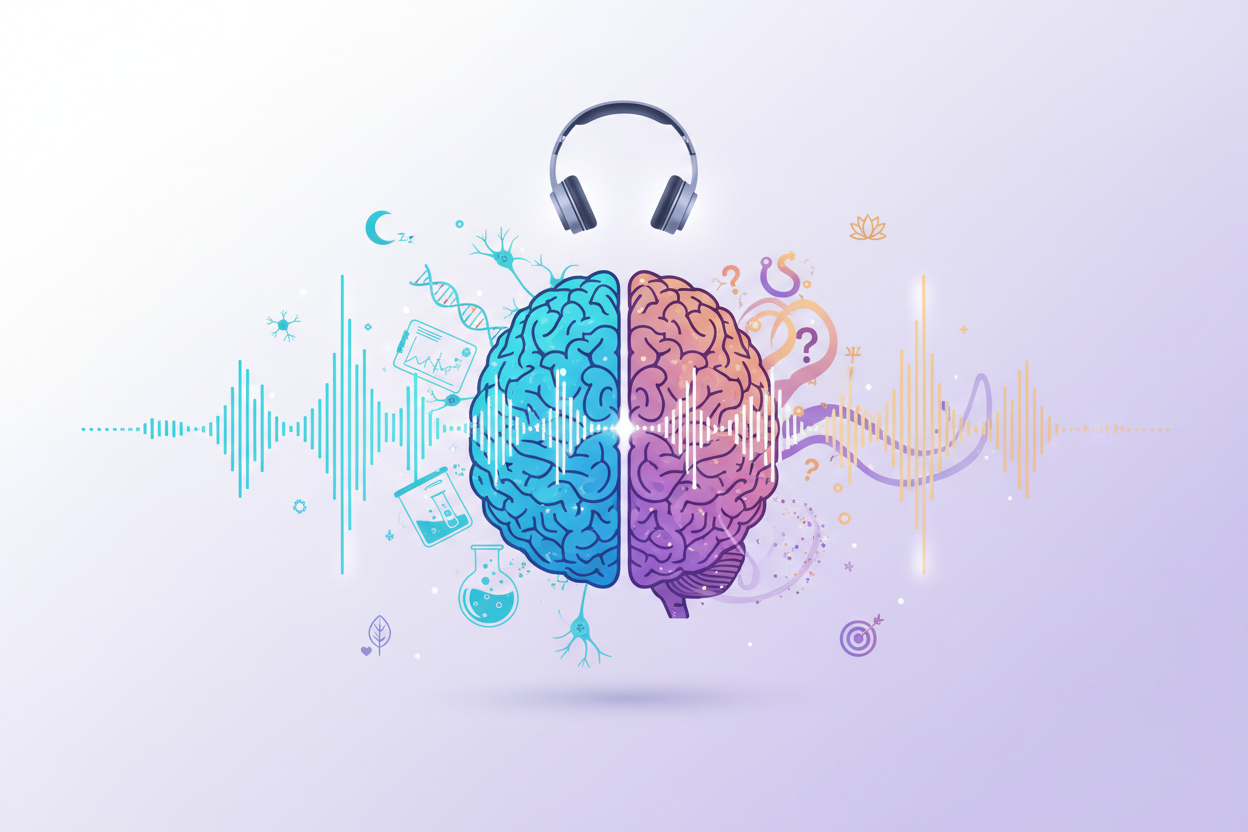
Binaural beats occur when two slightly different frequencies are played simultaneously in each ear. For example, if your left ear receives a 440 Hz tone and your right ear receives a 444 Hz tone, your brain perceives a rhythmic beating at 4 Hz – the difference between the two frequencies. This isn’t magic; it’s pure acoustics meeting neuroscience.
The concept isn’t new either. Heinrich Wilhelm Dove first discovered binaural beats in 1839, though the technology to study their effects on the brain wouldn’t emerge for another century. Today, you can find binaural beat tracks promising everything from deeper sleep to enhanced creativity, but separating the scientific facts from the marketing fiction requires a closer look.
The Neuroscience Behind Binaural Beats
Understanding how binaural beats work requires diving into the fascinating world of brainwave entrainment. Your brain naturally produces electrical activity at various frequencies, measured in hertz (Hz). These brainwaves correspond to different states of consciousness and mental activity.
When you listen to binaural beats, something remarkable happens in your brain’s auditory processing centers. The superior olivary complex, located in your brainstem, detects the phase differences between the two tones. This detection creates the perception of a beat frequency that doesn’t actually exist in the external environment – it’s entirely generated by your neural processing.
The theory of brainwave entrainment suggests that your brain’s electrical activity can synchronize with external rhythmic stimuli, including binaural beats. Different frequency ranges are associated with various mental states: delta waves (0.5-4 Hz) with deep sleep, theta waves (4-8 Hz) with meditation and creativity, alpha waves (8-14 Hz) with relaxed awareness, and beta waves (14-30 Hz) with focused attention.
However, the strength of this entrainment effect varies significantly between individuals and depends on factors like the specific frequencies used, the duration of exposure, and the listener’s current mental state.
Claims vs. Scientific Evidence
The internet is flooded with bold claims about binaural beats. Proponents suggest they can enhance memory, reduce anxiety, improve focus, induce lucid dreams, and even alter consciousness. While some of these claims have scientific backing, others venture into pseudoscientific territory.
Research on binaural beats has produced mixed results, which isn’t uncommon in neuroscience studies involving subjective experiences. Some studies show promising effects, while others find minimal or no significant changes compared to control groups. The challenge lies in the subjective nature of many reported benefits and the difficulty of conducting truly blind studies when participants can often detect the presence of binaural beats.
One consistent finding across multiple studies is that binaural beats can influence brainwave activity, though the extent and practical significance of this influence remain subjects of ongoing research. The key is understanding that correlation doesn’t equal causation – just because binaural beats can alter brainwave patterns doesn’t automatically mean they produce the claimed psychological or cognitive effects.
Proven Benefits of Binaural Beats
Despite the mixed research landscape, several studies have documented measurable effects of binaural beats on human physiology and psychology. Let me walk you through what the science actually supports.
Anxiety reduction represents one of the most consistently documented benefits. Multiple controlled studies have shown that listening to binaural beats in the theta frequency range (4-8 Hz) can significantly reduce pre-operative anxiety in patients. A 2017 study published in the Journal of Perianesthesia Nursing found that patients who listened to binaural beats before surgery reported lower anxiety levels compared to those who didn’t.
Sleep quality improvements have also shown promise in research settings. Studies examining binaural beats in the delta frequency range suggest they may help some individuals fall asleep faster and experience deeper sleep phases. However, the effects appear to be modest and don’t work equally well for everyone.
Attention and focus enhancement has received scientific attention, with some studies indicating that gamma frequency binaural beats (30-100 Hz) might improve sustained attention tasks. A study in the journal Psychological Research found that participants showed improved performance on attention-demanding tasks after listening to 40 Hz binaural beats.
Pain management represents another area where binaural beats show potential. Some research suggests that certain frequencies may help reduce perceived pain intensity, possibly through distraction mechanisms or by influencing the brain’s pain processing pathways.
Common Myths and Misconceptions
The popularity of binaural beats has unfortunately spawned numerous myths and exaggerated claims that deserve debunking. Understanding these misconceptions helps set realistic expectations and prevents disappointment.
One persistent myth suggests that binaural beats can instantly alter consciousness or induce drug-like states. While binaural beats can influence brainwave patterns, the changes are typically subtle and gradual. They’re not a shortcut to enlightenment or a replacement for meditation practice developed over years.
Another common misconception involves the idea that specific frequencies can target precise mental states with mathematical precision. The reality is far more complex – individual brain chemistry, personal history, current mood, and countless other factors influence how someone responds to binaural beats.
The “instant results” myth particularly needs addressing. Unlike taking a medication, binaural beats typically require consistent use over time to produce noticeable effects. Some people may experience benefits after a single session, but for most individuals, regular practice yields better results.
Perhaps most importantly, binaural beats aren’t a cure-all for serious mental health conditions. While they may serve as a helpful complementary tool for managing stress or improving relaxation, they shouldn’t replace professional medical treatment for anxiety disorders, depression, or other mental health concerns.
How to Use Binaural Beats Safely and Effectively
If you’re curious about exploring binaural beats, approaching them with realistic expectations and proper technique maximizes your chances of experiencing benefits while avoiding potential drawbacks.
Quality headphones are essential since the effect requires different frequencies reaching each ear independently. Earbuds can work, but over-ear headphones typically provide better frequency response and comfort for longer sessions. The volume should be comfortable – loud enough to hear clearly but not so loud as to cause discomfort or hearing damage.
Timing and duration matter significantly. Most research suggests sessions between 15-30 minutes for optimal effects. Longer sessions aren’t necessarily better and may lead to listener fatigue. The best time depends on your goals: delta frequencies for sleep preparation in the evening, alpha or theta for relaxation anytime, and beta or gamma for focus during work periods.
Creating the right environment enhances the experience. Find a quiet, comfortable space where you won’t be interrupted. Some people prefer lying down with eyes closed, while others find sitting comfortably works better. Experiment to discover what works best for you.
Safety considerations include avoiding binaural beats if you have a history of seizures, as rhythmic stimulation can potentially trigger seizure activity in susceptible individuals. Pregnant women and individuals with serious mental health conditions should consult healthcare providers before use.
The Bottom Line: What Science Really Says
After examining the research landscape, the truth about binaural beats lies somewhere between the enthusiastic claims of proponents and the complete dismissal by skeptics. The science shows that binaural beats can influence brainwave activity and may provide modest benefits for anxiety reduction, sleep improvement, and attention enhancement in some individuals.
However, these effects are generally subtle rather than dramatic, and individual responses vary considerably. Binaural beats work best when viewed as one tool among many for wellness and cognitive enhancement, not as a miracle solution to complex problems.
The placebo effect likely contributes to some reported benefits, but this doesn’t invalidate the experience – if listening to binaural beats helps you relax or focus better, the mechanism matters less than the result. The key is maintaining realistic expectations and not substituting binaural beats for proven treatments when dealing with serious health concerns.
Future research will likely provide clearer answers about optimal frequencies, durations, and applications. Until then, approaching binaural beats with curious skepticism and personal experimentation seems most reasonable.
Frequently Asked Questions
Do binaural beats actually work?
Scientific research shows that binaural beats can influence brainwave activity and may provide modest benefits for anxiety reduction, sleep quality, and attention. However, effects vary significantly between individuals, and the benefits are generally subtle rather than dramatic.
How long should I listen to binaural beats?
Most research suggests optimal session lengths of 15-30 minutes. Longer sessions aren’t necessarily more effective and may cause listener fatigue. Consistency over time appears more important than session duration.
Can binaural beats be dangerous?
Binaural beats are generally safe for most people when used at reasonable volumes. However, individuals with a history of seizures should avoid them, as rhythmic stimulation can potentially trigger seizure activity. Pregnant women and those with serious mental health conditions should consult healthcare providers first.
Do I need special headphones for binaural beats?
Yes, headphones or earbuds are essential since binaural beats require different frequencies reaching each ear independently. Quality over-ear headphones typically provide better results than basic earbuds, but expensive audiophile equipment isn’t necessary.
What’s the difference between binaural beats and regular music?
Binaural beats use specific frequency differences between ears to create a perceived beat that may influence brainwave patterns. Regular music, while potentially relaxing or energizing, doesn’t specifically target brainwave entrainment through precise frequency manipulation.
Can children use binaural beats safely?
Limited research exists on binaural beats’ effects in children. While likely safe at appropriate volumes, parents should consult pediatricians before introducing binaural beats to children, especially those with attention disorders or other neurological conditions.