
The Role of Brainwave Entrainment in Achieving Deep Meditation States ?
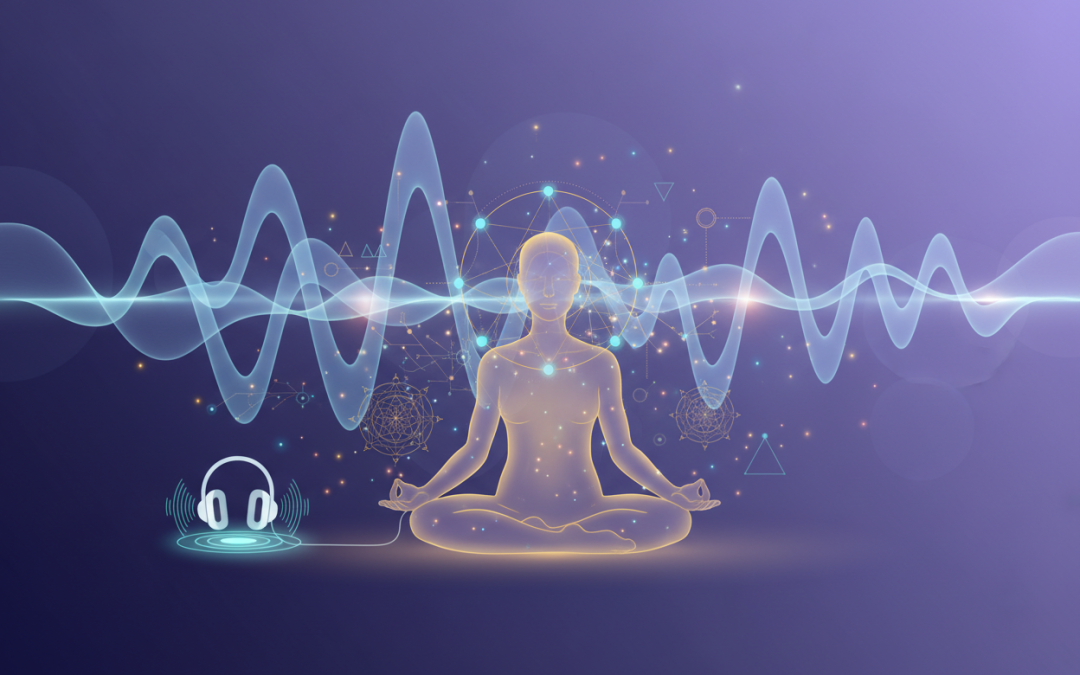
Have you ever wondered why some people seem to slip into deep meditation effortlessly while others struggle to quiet their racing minds? The answer might lie in understanding how our brainwaves work and how we can train them to achieve those blissful states of inner peace. Brainwave entrainment has emerged as a fascinating bridge between ancient meditation practices and modern neuroscience, offering a scientific approach to reaching profound meditative states.
In our fast-paced world, finding moments of genuine tranquility can feel like searching for a needle in a haystack. Yet, with the help of brainwave entrainment techniques, we’re discovering that deep meditation doesn’t have to remain an elusive goal reserved for seasoned monks. This revolutionary approach is transforming how we understand and practice meditation, making profound states of consciousness more accessible than ever before.
Table of Contents
• Understanding Brainwave Patterns and Meditation States
• What is Brainwave Entrainment?
• The Science Behind Entrainment and Deep Meditation
• Types of Brainwave Entrainment for Meditation
• Benefits of Using Entrainment for Meditation Practice
• How to Get Started with Brainwave Entrainment
• Common Challenges and Solutions
• Frequently Asked Questions
Understanding Brainwave Patterns and Meditation States ?
Before diving into brainwave entrainment, it’s essential to understand what happens in our brains during different states of consciousness. Our brains constantly produce electrical activity, creating patterns called brainwaves that can be measured in frequencies.
During normal waking consciousness, our brains typically operate in beta waves (13-30 Hz), characterized by active thinking, problem-solving, and everyday awareness. However, when we enter meditative states, something remarkable happens – our brainwave patterns shift dramatically.
Alpha waves (8-12 Hz) emerge during light meditation and relaxation, creating that peaceful, yet alert state many meditators recognize. As we go deeper, theta waves (4-8 Hz) take over, associated with profound meditation, creativity, and deep introspection. The holy grail for many practitioners is reaching delta waves (0.5-4 Hz), typically associated with deep sleep but also with the most profound meditative states where ego dissolution and transcendent experiences occur.
What’s fascinating is that experienced meditators can consciously access these slower brainwave states while remaining awake and aware. This ability doesn’t happen overnight – it usually takes years of dedicated practice. Or does it? This is where brainwave entrainment enters the picture, potentially accelerating this natural process.
What is Brainwave Entrainment? ?
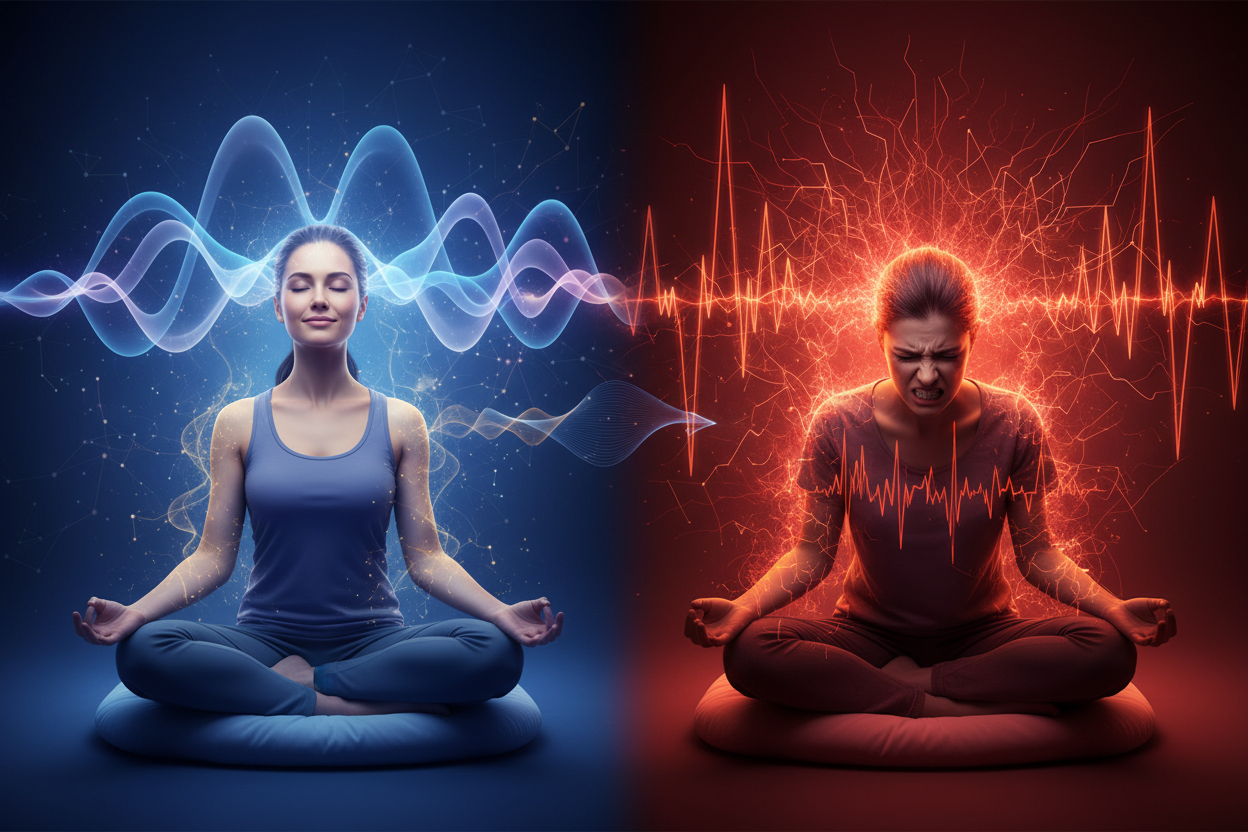
Brainwave entrainment is based on a natural phenomenon where our brains tend to synchronize with external rhythmic stimuli. Think of it as your brain’s tendency to “tune in” to repetitive sounds, lights, or vibrations, gradually matching its electrical activity to these external frequencies.
This isn’t some new-age concept – it’s rooted in solid neuroscience. The principle was first discovered in 1665 by Dutch physicist Christiaan Huygens, who noticed that pendulum clocks in the same room would eventually synchronize their swings. Our brains exhibit similar behavior when exposed to consistent rhythmic input.
In the context of meditation, brainwave entrainment uses specific audio or visual frequencies to gently guide the brain into desired states. Instead of spending years learning to naturally slow down your brainwaves through traditional meditation alone, entrainment provides a technological shortcut that can help you experience these states more quickly and reliably.
The beauty of this approach lies in its accessibility. You don’t need to be a meditation master or have perfect concentration. The entrainment process works on a neurological level, helping your brain naturally shift into meditative frequencies even if your conscious mind is still somewhat active.
The Science Behind Entrainment and Deep Meditation ?
The scientific foundation of brainwave entrainment rests on several key neurological principles. When we expose the brain to rhythmic stimuli at specific frequencies, neurons begin to fire in sync with these patterns through a process called frequency following response (FFR).
Research has shown that different brainwave frequencies correspond to distinct states of consciousness and cognitive functions. For instance, studies using EEG technology have consistently demonstrated that experienced meditators show increased alpha and theta wave activity during their practice, correlating with reported feelings of peace, insight, and transcendence.
What makes entrainment particularly powerful for meditation is its ability to create what neuroscientists call “neural coherence” – a state where different regions of the brain begin working in harmony. This synchronized brain activity is often associated with enhanced creativity, emotional balance, and the profound sense of unity that many meditators seek.
Recent neuroimaging studies have revealed that brainwave entrainment can produce measurable changes in brain structure and function. Regular use has been linked to increased gray matter density in areas associated with attention, emotional regulation, and self-awareness – the same changes observed in long-term meditation practitioners.
Types of Brainwave Entrainment for Meditation ?
Several different methods of brainwave entrainment have been developed, each with its unique characteristics and applications for meditation practice.
Binaural Beats represent perhaps the most popular form of auditory entrainment. This technique presents slightly different frequencies to each ear – for example, 200 Hz to the left ear and 210 Hz to the right ear. Your brain processes the mathematical difference (10 Hz in this case) as a “phantom” beat, gradually synchronizing to this target frequency. For meditation, binaural beats in the alpha (8-12 Hz) and theta (4-8 Hz) ranges are particularly effective.
Monaural Beats work differently by presenting a single, pulsing tone that alternates in volume. Unlike binaural beats, these can be heard through speakers and don’t require headphones. Many practitioners find monaural beats more immediately noticeable and easier to follow during meditation.
Isochronic Tones use distinct, evenly-spaced pulses of sound to create entrainment. These sharp, rhythmic tones are often considered the most effective form of auditory entrainment because they provide clear, unambiguous timing cues for the brain to follow.
Light and Sound Machines combine visual and auditory entrainment, using flashing LED lights along with synchronized audio frequencies. This multi-sensory approach can be particularly powerful for deep meditation states, as it engages multiple neural pathways simultaneously.
Benefits of Using Entrainment for Meditation Practice ?
The integration of brainwave entrainment into meditation practice offers numerous advantages that extend far beyond simply achieving relaxation. One of the most significant benefits is the acceleration of the learning curve for meditation beginners.
Traditional meditation can be challenging for newcomers who struggle with racing thoughts and difficulty maintaining focus. Brainwave entrainment provides a gentle neurological anchor, making it easier to access meditative states even during the early stages of practice. This can be incredibly encouraging for beginners who might otherwise become frustrated and abandon their meditation journey.
For experienced practitioners, entrainment offers the ability to explore deeper states more consistently. Even seasoned meditators have days when their practice feels scattered or shallow. Entrainment can help stabilize and deepen these sessions, providing a reliable pathway to profound states regardless of external circumstances or mental conditions.
The stress-reduction benefits are particularly noteworthy. Regular use of brainwave entrainment for meditation has been shown to significantly reduce cortisol levels, lower blood pressure, and improve overall stress resilience. Many users report better sleep quality, enhanced emotional regulation, and increased feelings of overall well-being.
From a cognitive perspective, entrainment-assisted meditation can enhance creativity, improve focus, and boost problem-solving abilities. The synchronized brain states achieved through this practice often lead to increased insight and innovative thinking that extends into daily life.
How to Get Started with Brainwave Entrainment ?
Beginning your journey with brainwave entrainment doesn’t require expensive equipment or extensive technical knowledge. The most accessible starting point is downloading high-quality binaural beat or isochronic tone recordings designed specifically for meditation.
When selecting your first entrainment audio, look for tracks that gradually transition from higher frequencies down to your target meditation state. A good beginner session might start around 12 Hz (upper alpha) and slowly descend to 6-8 Hz (theta) over a 20-30 minute period. This gradual transition allows your brain to naturally follow the frequency changes without jarring shifts.
Your listening environment plays a crucial role in effectiveness. Choose a quiet, comfortable space where you won’t be interrupted. If using binaural beats, high-quality headphones are essential since the effect depends on delivering precise frequencies to each ear independently. For monaural beats and isochronic tones, good speakers can work just as well.
Start with shorter sessions – perhaps 15-20 minutes – and gradually increase duration as you become more comfortable with the process. It’s normal to feel slightly disoriented or deeply relaxed after your first few sessions, so allow yourself time to gently return to normal awareness.
Consistency is key to experiencing the full benefits. Try to practice at the same time each day, ideally when you’re naturally more relaxed, such as early morning or before bedtime. Keep a meditation journal to track your experiences and notice patterns in how different frequencies affect your state of mind.
Common Challenges and Solutions ?
While brainwave entrainment can be incredibly effective, practitioners sometimes encounter challenges that can be easily addressed with the right approach.
Some people initially find the rhythmic sounds distracting rather than helpful. If this occurs, try starting with very subtle entrainment tracks or those that incorporate natural sounds like ocean waves or rainfall. Your brain will still entrain to the underlying frequencies while your conscious mind focuses on the more pleasant ambient sounds.
Headaches or discomfort can occasionally occur, especially when starting with frequencies that are too low or sessions that are too long. Begin with higher alpha frequencies (10-12 Hz) and shorter durations, gradually working your way down to deeper states as your brain adapts to the process.
If you find yourself falling asleep during sessions, this usually indicates that you’re either too tired or using frequencies that are too low for your current state. Try practicing when you’re more alert or using slightly higher frequencies that promote relaxed awareness rather than deep sleep states.
Some practitioners worry about becoming dependent on entrainment technology. While these tools are incredibly helpful, they should complement, not replace, traditional meditation techniques. Use entrainment as training wheels that help you experience and recognize different states of consciousness, gradually developing the ability to access them naturally.
Frequently Asked Questions ?
Is brainwave entrainment safe for everyone?
Brainwave entrainment is generally considered safe for most people. However, individuals with epilepsy, seizure disorders, or certain psychiatric conditions should consult with healthcare providers before use. Pregnant women and children should also seek medical advice before beginning any entrainment practice.
How long does it take to see results from brainwave entrainment?
Many people notice immediate relaxation effects from their first session, but deeper benefits typically develop over 2-4 weeks of regular practice. Some practitioners report significant improvements in meditation depth and stress levels within just a few sessions.
Can I use brainwave entrainment while doing other activities?
For meditation purposes, it’s best to use entrainment during dedicated practice sessions where you can focus entirely on the experience. Using it during other activities may reduce effectiveness and could potentially be distracting or unsafe.
Do I need expensive equipment to benefit from brainwave entrainment?
Not at all! While specialized devices exist, high-quality audio recordings played through decent headphones or speakers can be highly effective. Many excellent entrainment tracks are available for free or at low cost online.
Will brainwave entrainment work if I’m a beginner to meditation?
Absolutely! In fact, beginners often find entrainment particularly helpful because it provides a neurological anchor that makes it easier to access meditative states. Many meditation teachers now incorporate these tools into their instruction for new students.
Can brainwave entrainment replace traditional meditation practices?
While entrainment is a powerful tool, it works best when combined with traditional meditation techniques rather than replacing them entirely. Think of it as a valuable supplement that can enhance and accelerate your overall practice.
Conclusion: Embracing the Future of Meditation ?
Brainwave entrainment represents an exciting convergence of ancient wisdom and modern technology, offering a scientifically-backed pathway to the deep meditative states that humans have sought for millennia. By understanding and working with our brain’s natural tendency to synchronize with rhythmic stimuli, we can accelerate our meditation practice and access profound states of consciousness with greater ease and consistency.
The beauty of this approach lies not in replacing traditional meditation methods, but in enhancing them. Whether you’re a complete beginner struggling to quiet your mind or an experienced practitioner seeking to explore deeper territories of consciousness, brainwave entrainment offers valuable support for your journey.
As we continue to uncover the mysteries of consciousness and the brain’s remarkable plasticity, tools like brainwave entrainment will likely play an increasingly important role in meditation and personal development. The technology is becoming more sophisticated, accessible, and effective, opening doors to experiences that were once available only to the most dedicated practitioners.
Remember that meditation, whether enhanced by technology or practiced in its traditional forms, is ultimately about discovering the profound peace and wisdom that already exist within you. Brainwave entrainment simply provides a gentle, scientific nudge to help you access these natural states more easily. As you explore this fascinating intersection of science and spirituality, approach it with curiosity, patience, and an open mind – the depths of consciousness that await your exploration are truly limitless.
Roshiwave Meditation Mind Machine
Add CTA sections description.