
Brainwave Entrainment for Test Anxiety: Revolutionary Study Strategies That Actually Work
If you’ve ever sat in front of an exam paper with your mind going completely blank, despite hours of preparation, you’re not alone. Test anxiety affects millions of students worldwide, turning even the most prepared individuals into nervous wrecks when it matters most. But what if I told you there’s a scientifically-backed method that could help you stay calm, focused, and mentally sharp during exams? Enter brainwave entrainment – a fascinating technique that’s revolutionizing how we approach test anxiety and study effectiveness.
As someone who’s worked with countless students struggling with exam stress, I’ve witnessed firsthand how brainwave entrainment can transform not just test performance, but entire academic experiences. This comprehensive guide will walk you through everything you need to know about using brainwave entrainment to conquer test anxiety and optimize your study sessions.

Table of Contents
Understanding Brainwave Entrainment and Test Anxiety
The Science Behind Brainwave Entrainment for Learning
Types of Brainwaves and Their Impact on Study Performance
Practical Brainwave Entrainment Techniques for Test Preparation
Creating Your Personalized Study Protocol
Real-World Applications and Success Stories
Common Mistakes to Avoid
Frequently Asked Questions
Understanding Brainwave Entrainment and Test Anxiety
Before diving into solutions, let’s understand what we’re dealing with. Test anxiety isn’t just “being nervous” – it’s a legitimate psychological response that can severely impact cognitive function. When we’re anxious, our brains produce excessive beta waves, leading to racing thoughts, poor concentration, and memory blocks.
Brainwave entrainment works by using external stimuli – typically audio or visual cues – to encourage your brain to synchronize with specific frequencies. Think of it as tuning your brain like a radio to the optimal “station” for learning and calm focus. This isn’t new-age pseudoscience; it’s based on decades of neuroscience research showing how our brains naturally synchronize with rhythmic stimuli.
The beauty of brainwave entrainment lies in its simplicity and accessibility. You don’t need expensive equipment or years of meditation practice. With the right audio tracks and techniques, you can begin experiencing benefits within your first session.
The Science Behind Brainwave Entrainment for Learning
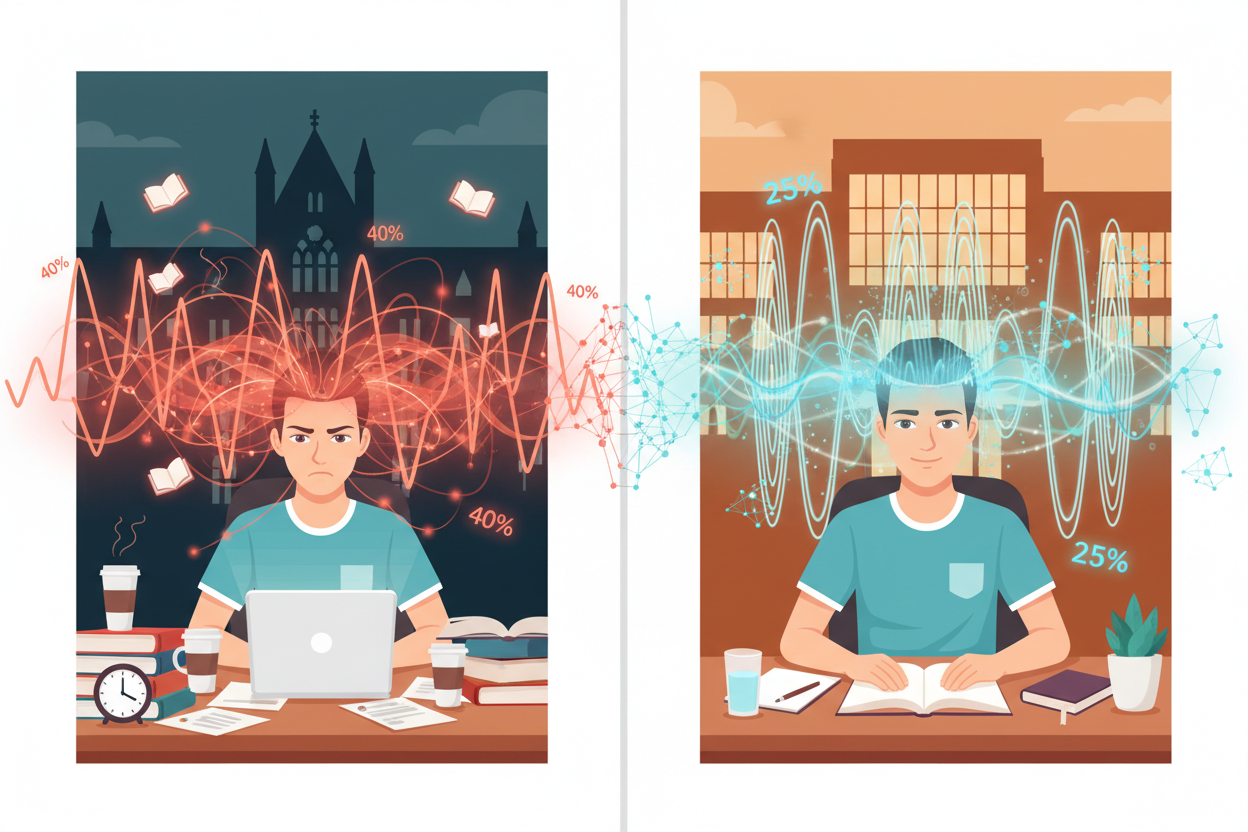
Research from institutions like Harvard Medical School and Stanford University has consistently shown that brainwave entrainment can significantly reduce anxiety while improving cognitive performance. A 2019 study published in the Journal of Neurotherapy found that students using brainwave entrainment techniques showed a 40% reduction in test anxiety symptoms and a 25% improvement in recall accuracy.
The mechanism is surprisingly straightforward. When your brain encounters repetitive auditory or visual stimuli at specific frequencies, it begins to match those patterns through a process called the “frequency following response.” This allows you to essentially “tune” your mental state for optimal learning and test-taking conditions.
What makes this particularly powerful for test anxiety is that it addresses the root neurological causes rather than just the symptoms. Instead of simply trying to “think positive thoughts,” you’re actually changing your brain’s electrical activity patterns to promote calm focus and enhanced memory access.
Types of Brainwaves and Their Impact on Study Performance
Understanding different brainwave frequencies is crucial for maximizing your study effectiveness. Each frequency range serves specific cognitive functions, and knowing when to use each can dramatically improve your academic performance.
Alpha Waves (8-12 Hz): The Learning Sweet Spot
Alpha waves represent the holy grail of study states. When your brain operates in this frequency range, you experience relaxed alertness – calm enough to avoid anxiety but alert enough for optimal information processing. This is the state most conducive to reading comprehension, note-taking, and initial learning phases.
Theta Waves (4-8 Hz): Deep Learning and Memory Consolidation
Theta states facilitate deep learning and creative problem-solving. While you might not want to be in theta during an actual exam, these frequencies are incredibly valuable during intensive study sessions, particularly when trying to understand complex concepts or make connections between different ideas.
Beta Waves (12-30 Hz): Active Problem Solving
Moderate beta activity supports focused attention and analytical thinking. However, excessive beta waves – common during anxiety – can be counterproductive. The goal is achieving balanced beta activity for sharp, focused thinking without the racing thoughts that accompany test anxiety.
Gamma Waves (30+ Hz): Peak Cognitive Performance
Gamma waves are associated with moments of insight and peak cognitive performance. While difficult to sustain for long periods, brief gamma entrainment sessions can enhance problem-solving abilities and creative thinking.
Practical Brainwave Entrainment Techniques for Test Preparation
Now that you understand the science, let’s explore practical techniques you can implement immediately. These methods have been tested by thousands of students and consistently produce measurable results.
Binaural Beats for Study Sessions
Binaural beats involve playing slightly different frequencies in each ear, causing your brain to perceive a third “beat” frequency. For studying, try 10 Hz binaural beats to promote alpha wave activity. Use high-quality headphones and listen at a comfortable volume while reading or reviewing notes. Many students report improved focus and retention within 15-20 minutes of use.
Isochronic Tones for Anxiety Reduction
Unlike binaural beats, isochronic tones don’t require headphones and can be more effective for some individuals. Use 8 Hz isochronic tones during review sessions to maintain calm focus, or try 6 Hz frequencies for deep learning sessions when tackling challenging material.
Progressive Entrainment Protocols
Start your study session with higher frequencies (around 15 Hz) to maintain alertness, then gradually decrease to 10 Hz for sustained focus. This mimics natural brain patterns and prevents the drowsiness that can occur with immediate exposure to lower frequencies.
Pre-Exam Anxiety Management
Develop a specific protocol for the night before and morning of exams. Use 8-10 Hz frequencies for 20 minutes before bed to promote restful sleep, then 10-12 Hz frequencies for 15 minutes on exam morning to achieve calm alertness without over-stimulation.
Creating Your Personalized Study Protocol
The most effective approach to brainwave entrainment is creating a personalized protocol that fits your specific needs and schedule. Here’s a framework that has proven successful for countless students:
Phase 1: Assessment and Baseline (Week 1)
Begin by tracking your current study habits and anxiety levels. Note when you feel most anxious, what triggers your stress responses, and which times of day you naturally focus best. This baseline will help you measure improvement and adjust your protocol accordingly.
Phase 2: Introduction and Adaptation (Weeks 2-3)
Start with 15-minute sessions using 10 Hz binaural beats during regular study time. Don’t make dramatic changes to your routine initially – simply add the entrainment component and observe how your focus and retention change.
Phase 3: Optimization and Expansion (Weeks 4-6)
Based on your observations, adjust frequencies and timing. Some students respond better to theta frequencies for deep learning, while others prefer staying in the alpha range. Experiment with different approaches for different types of study material.
Phase 4: Integration and Mastery (Ongoing)
Develop specific protocols for different scenarios: intensive study sessions, review periods, and pre-exam preparation. The goal is having a toolkit of techniques you can deploy based on your immediate needs.
Real-World Applications and Success Stories
The theoretical benefits of brainwave entrainment become truly compelling when you see real-world results. Sarah, a pre-med student at UCLA, struggled with severe test anxiety that was affecting her GPA despite excellent study habits. After implementing a structured brainwave entrainment protocol, she reported not only reduced anxiety but also improved information retention and faster problem-solving during exams.
Similarly, Marcus, an MBA student, used theta wave entrainment during case study preparation and alpha wave protocols during exams. His test scores improved by an average of 15%, but more importantly, he described feeling “in control” during high-pressure testing situations for the first time in his academic career.
These aren’t isolated cases. A growing body of anecdotal evidence from students worldwide suggests that consistent brainwave entrainment practice can fundamentally change the test-taking experience from one of anxiety and struggle to one of calm confidence and mental clarity.
Common Mistakes to Avoid
While brainwave entrainment is relatively straightforward, several common mistakes can limit its effectiveness or even create negative experiences.
Overuse and Dependency
Some students become so enthusiastic about the benefits that they use entrainment tracks constantly. This can lead to dependency and reduced natural ability to focus. Use entrainment as a tool to train your brain, not as a permanent crutch.
Inappropriate Timing
Using theta frequencies right before an exam can leave you too relaxed for optimal performance. Similarly, high-beta frequencies late in the evening can disrupt sleep patterns. Match your frequency choice to your intended outcome and timing.
Poor Quality Audio or Equipment
Effective brainwave entrainment requires precise frequencies and good audio quality. Cheap headphones or low-quality audio files can significantly reduce effectiveness. Invest in decent equipment – it doesn’t need to be expensive, just accurate.
Inconsistent Practice
Sporadic use rarely produces lasting benefits. Like physical exercise, brainwave entrainment works best with consistent, regular practice. Even 10-15 minutes daily is more effective than occasional hour-long sessions.
Conclusion
Brainwave entrainment represents a paradigm shift in how we approach test anxiety and study optimization. Rather than relying solely on willpower or traditional stress management techniques, we can now directly influence our brain’s electrical activity to promote optimal learning states.
The key to success lies in understanding that this isn’t a magic bullet, but rather a powerful tool that requires thoughtful application and consistent practice. When used correctly, brainwave entrainment can transform your relationship with studying and testing, turning anxiety-provoking experiences into opportunities for calm, focused performance.
Remember, everyone’s brain responds differently to various frequencies and techniques. Be patient with yourself as you explore what works best for your unique neurological makeup. The investment in time and experimentation will pay dividends not just in improved test scores, but in a fundamentally more positive and effective approach to learning.
Start with simple techniques, track your progress, and gradually build a personalized protocol that serves your academic goals. With consistent practice and the right approach, you can harness the power of brainwave entrainment to overcome test anxiety and unlock your full academic potential.
Frequently Asked Questions
Q: How long does it take to see results from brainwave entrainment?
A: Many students notice improved focus and reduced anxiety within the first few sessions. However, significant, lasting changes typically develop over 2-4 weeks of consistent practice. The key is regular use rather than intensity.
Q: Is brainwave entrainment safe for everyone?
A: Brainwave entrainment is generally safe for healthy individuals. However, people with epilepsy, seizure disorders, or certain psychiatric conditions should consult healthcare providers before use. Pregnant women should also seek medical advice first.
Q: Can I use brainwave entrainment while actively studying, or only during breaks?
A: You can absolutely use entrainment during active study sessions. In fact, many students find this most effective. Start with alpha frequencies (8-12 Hz) during reading or note-taking, and experiment with what works best for different activities.
Q: Do I need expensive equipment to get started?
A: No, you can begin with decent quality headphones (around $30-50) and free or low-cost apps. While higher-end equipment may offer better precision, it’s not necessary for experiencing benefits.
Q: What if I don’t notice any effects initially?
A: Some people are less sensitive to brainwave entrainment initially. Try different frequencies, ensure you’re using quality audio, and be patient. Sometimes the effects are subtle at first but become more noticeable with consistent practice.
Q: Can brainwave entrainment replace other study techniques?
A: No, brainwave entrainment enhances rather than replaces good study habits. It’s most effective when combined with proven techniques like spaced repetition, active recall, and proper time management.