

How to Track Your Progress with Brainwave Entrainment: A Complete Guide to Measuring Your Mental Transformation
Table of Contents
1. Introduction to Brainwave Entrainment Progress Tracking
2. Understanding Brainwave Entrainment Basics
3. Why Tracking Your Progress Matters
4. Essential Metrics to Monitor During Your Journey
5. Tools and Methods for Measuring Brainwave Entrainment Results
6. Creating Your Personal Progress Tracking System
7. Common Challenges and How to Overcome Them
8. Advanced Tracking Techniques for Serious Practitioners
9. Conclusion
10. Frequently Asked Questions
Introduction to Brainwave Entrainment Progress Tracking
Have you ever wondered if those brainwave entrainment sessions you’ve been doing are actually working? You’re not alone. Thousands of people worldwide use binaural beats, isochronic tones, and other forms of brainwave entrainment to enhance their mental performance, reduce stress, and improve sleep quality. But here’s the thing – without proper tracking, you might be missing out on recognizing the incredible progress you’re making.

Tracking your progress with brainwave entrainment isn’t just about collecting data; it’s about understanding your brain’s response to different frequencies and optimizing your practice for maximum benefit. Whether you’re a beginner who just started experimenting with alpha waves or an experienced practitioner diving deep into gamma frequencies, having a systematic approach to monitoring your results can transform your entire experience.
In this comprehensive guide, we’ll explore practical methods to measure your brainwave entrainment progress, discuss the tools that can help you along the way, and share insights that will help you create a personalized tracking system that actually works for your lifestyle and goals.
Understanding Brainwave Entrainment Basics
Before diving into tracking methods, let’s quickly review what brainwave entrainment actually does to your brain. When you listen to specific audio frequencies, your brain naturally synchronizes its electrical activity to match those frequencies – a phenomenon called the frequency following response. This synchronization can help you achieve desired mental states more easily than through traditional methods alone.
Different brainwave frequencies correspond to different mental states. Delta waves (0.5-4 Hz) are associated with deep sleep and healing, theta waves (4-8 Hz) with deep meditation and creativity, alpha waves (8-13 Hz) with relaxed focus, beta waves (13-30 Hz) with active concentration, and gamma waves (30-100 Hz) with heightened awareness and cognitive processing.
Understanding these basics helps you set realistic expectations for what you should be tracking and when you might expect to see changes in your mental state and overall well-being.
Why Tracking Your Progress Matters
Many people start using brainwave entrainment with high hopes but give up after a few weeks because they don’t notice immediate dramatic changes. This is where progress tracking becomes invaluable. The benefits of brainwave entrainment often develop gradually, and without proper documentation, you might miss subtle but significant improvements in your cognitive function, emotional regulation, or sleep quality.
Tracking also helps you identify which frequencies and session lengths work best for your unique brain chemistry. What works wonderfully for your friend might not be optimal for you, and systematic tracking helps you discover your personal sweet spots for different goals.
Additionally, having concrete data about your progress can be incredibly motivating. When you can see measurable improvements in your focus, stress levels, or sleep quality over time, you’re more likely to stick with your practice and continue reaping the benefits.
Essential Metrics to Monitor During Your Journey
The key to effective progress tracking lies in monitoring the right metrics. Start with these fundamental areas that most people experience improvements in when using brainwave entrainment consistently.
Sleep quality deserves top priority in your tracking efforts. Monitor how long it takes you to fall asleep, how many times you wake up during the night, and how refreshed you feel upon waking. Many practitioners notice improvements in sleep within the first few weeks of regular practice.
Stress and anxiety levels can be tracked using simple daily ratings on a scale of 1-10. Pay attention to your stress response in typical trigger situations and note any changes in your overall anxiety baseline. Some people find it helpful to track stress levels both before and after entrainment sessions.
Focus and concentration metrics might include how long you can maintain attention on a single task, how easily you get distracted, and your overall productivity during work or study sessions. These improvements often become noticeable after 2-4 weeks of consistent practice.
Mood and emotional regulation are equally important to monitor. Track your general mood throughout the day, emotional reactivity to stressful situations, and overall sense of well-being. Many users report feeling more emotionally balanced after incorporating brainwave entrainment into their routine.
Tools and Methods for Measuring Brainwave Entrainment Results
You don’t need expensive equipment to track your progress effectively. A simple journal or smartphone app can be incredibly powerful when used consistently. The key is choosing tools that you’ll actually use regularly without feeling overwhelmed.
Digital tracking apps offer convenience and often include helpful features like charts and trend analysis. Popular options include mood tracking apps, sleep monitoring applications, and general wellness journals that allow custom metrics. Many of these apps can send daily reminders to log your data, which helps maintain consistency.
Traditional pen-and-paper journals work exceptionally well for many people. There’s something powerful about physically writing down your observations and progress. Consider creating a simple template with the metrics you want to track, leaving space for qualitative observations about your experiences.
Wearable devices can provide objective data about sleep patterns, heart rate variability, and activity levels. While not specifically designed for brainwave entrainment tracking, these devices can offer valuable insights into how your overall physiology responds to your practice.
For those interested in more advanced tracking, EEG devices designed for home use can actually measure your brainwave activity before, during, and after entrainment sessions. While more expensive, these tools provide direct feedback about how your brain responds to different frequencies.
Creating Your Personal Progress Tracking System
The most effective tracking system is one that fits seamlessly into your daily routine. Start by identifying 3-5 key metrics that align with your primary goals for using brainwave entrainment. Trying to track too many variables at once often leads to tracking fatigue and abandoned efforts.
Establish a consistent tracking schedule that works with your lifestyle. Some people prefer to log data immediately after their entrainment sessions, while others find it more effective to do a quick review each evening before bed. The timing matters less than the consistency.
Create simple rating scales for subjective measures. For example, rate your stress level from 1-10, with 1 being completely calm and 10 being extremely stressed. Having clear definitions for each number helps ensure consistent ratings over time.
Include space for qualitative observations alongside your quantitative data. Sometimes the most valuable insights come from noting unexpected changes or subtle shifts that don’t fit neatly into numerical ratings.
Set up regular review periods to analyze your data and adjust your practice accordingly. Weekly or bi-weekly reviews help you identify patterns and make informed decisions about frequency selection, session length, and timing.
Common Challenges and How to Overcome Them
One of the biggest challenges in tracking brainwave entrainment progress is maintaining consistency with data collection. Life gets busy, and it’s easy to skip a day or two of tracking. To overcome this, make your tracking system as simple and quick as possible. A 30-second daily check-in is infinitely more valuable than an elaborate system you abandon after two weeks.
Another common issue is expecting too much too soon. Brainwave entrainment typically produces gradual changes rather than dramatic overnight transformations. Set realistic expectations and remember that subtle improvements compound over time into significant changes.
Some people struggle with the subjective nature of many tracking metrics. While it’s true that rating your mood or stress level involves some subjectivity, these measurements become more reliable and useful over time as you develop a consistent internal reference scale.
Inconsistent practice schedules can make it difficult to identify what’s actually working. Try to maintain some consistency in your entrainment routine while you’re establishing baseline measurements and identifying effective protocols for your needs.
Advanced Tracking Techniques for Serious Practitioners
For those who want to dive deeper into progress tracking, consider implementing more sophisticated measurement techniques. Heart rate variability (HRV) monitoring can provide insights into your autonomic nervous system’s response to different brainwave frequencies.
Cognitive testing apps can help you track improvements in specific mental functions like working memory, processing speed, or attention span. Regular testing using standardized cognitive assessments can reveal improvements that might not be obvious in daily life.
Experiment with A/B testing different approaches. For example, spend two weeks using theta frequencies for meditation, then switch to alpha frequencies for the next two weeks while keeping all other variables constant. This systematic approach helps you identify which protocols work best for specific goals.
Consider tracking environmental and lifestyle factors that might influence your results. Sleep quality, caffeine intake, exercise, and stress levels can all impact how effectively you respond to brainwave entrainment.
Conclusion
Tracking your progress with brainwave entrainment transforms a passive listening experience into an active journey of self-discovery and optimization. By systematically monitoring key metrics like sleep quality, stress levels, focus, and mood, you gain valuable insights into how your brain responds to different frequencies and protocols.
Remember that the best tracking system is the one you’ll actually use consistently. Start simple, focus on the metrics that matter most to your goals, and gradually refine your approach as you learn what works for your unique situation. The small investment of time spent tracking your progress pays dividends in helping you optimize your brainwave entrainment practice for maximum benefit.
Whether you choose a simple journal, a smartphone app, or advanced monitoring devices, the key is consistency and patience. Give yourself at least 4-6 weeks of regular practice and tracking before making major adjustments to your routine. Your brain is remarkably adaptable, but meaningful changes take time to develop and become apparent.
Start your tracking journey today, and discover just how powerful brainwave entrainment can be when you have the data to guide your practice toward optimal results.
Frequently Asked Questions
How long should I track my progress before expecting to see results?
Most people begin noticing subtle changes within 2-3 weeks of consistent practice, with more significant improvements becoming apparent after 4-6 weeks. However, some benefits like improved sleep quality may be noticeable within the first week, while cognitive enhancements might take longer to develop.
What’s the minimum amount of data I need to track to see meaningful patterns?
Focus on 3-5 key metrics that align with your primary goals. Tracking too many variables can be overwhelming and lead to inconsistent data collection. Quality and consistency matter more than quantity when it comes to progress tracking.
Should I track data every day or is a few times per week sufficient?
Daily tracking provides the most comprehensive picture of your progress, but tracking 4-5 times per week can still yield valuable insights. The key is consistency – regular tracking at whatever frequency you can maintain is more valuable than sporadic detailed tracking.
How do I know if the changes I’m tracking are actually due to brainwave entrainment?
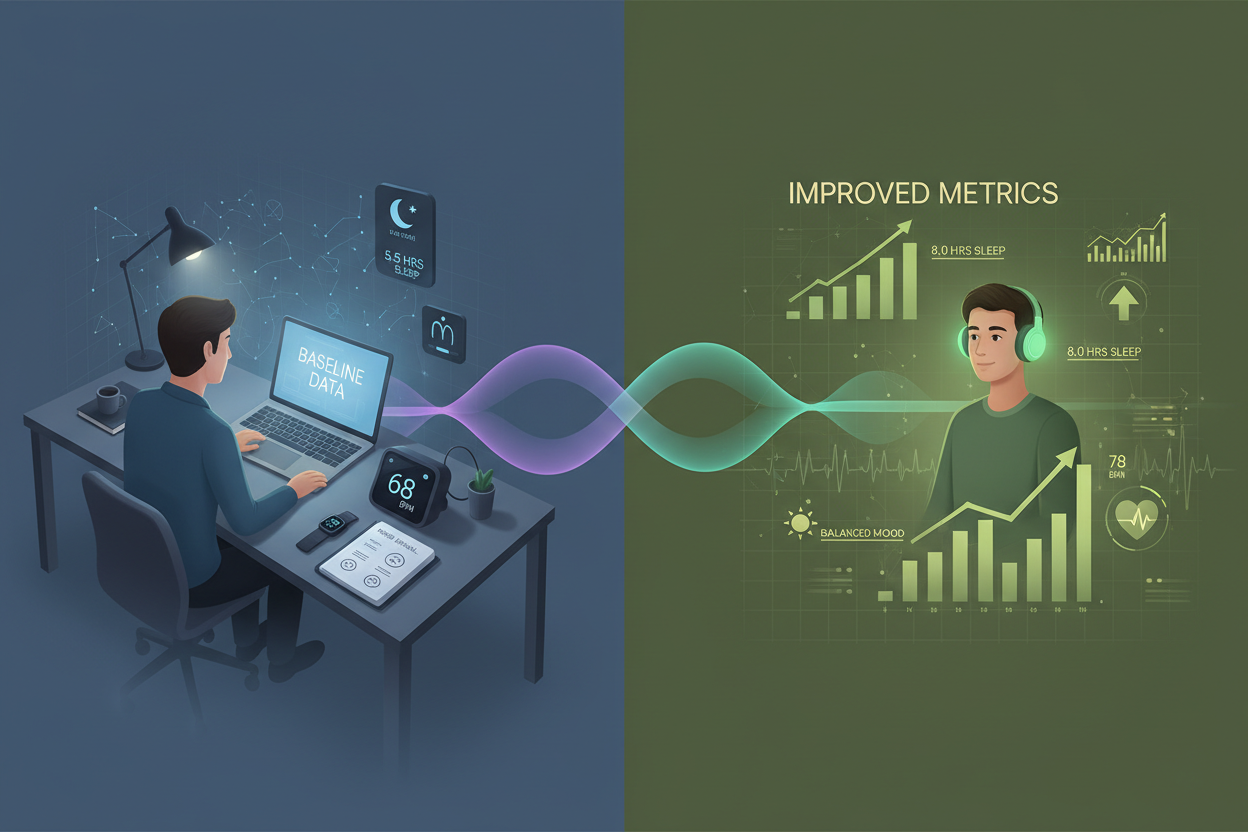
While it’s impossible to control for all variables in daily life, you can increase confidence in your results by maintaining consistent tracking before starting brainwave entrainment to establish a baseline, then monitoring changes after beginning your practice. Significant improvements that correlate with your entrainment routine are likely related to your practice.
What should I do if I’m not seeing the progress I expected after several weeks of tracking?
If progress seems slow, review your data for subtle improvements you might have missed, consider adjusting your entrainment frequency or session length, ensure you’re practicing consistently, and remember that some people respond more slowly than others. Consider consulting with a brainwave entrainment practitioner if you continue to have concerns.