Layout Image

Introducing the pROSHI

This is the first article in our series about the pROSHI Neurodynamic Activator

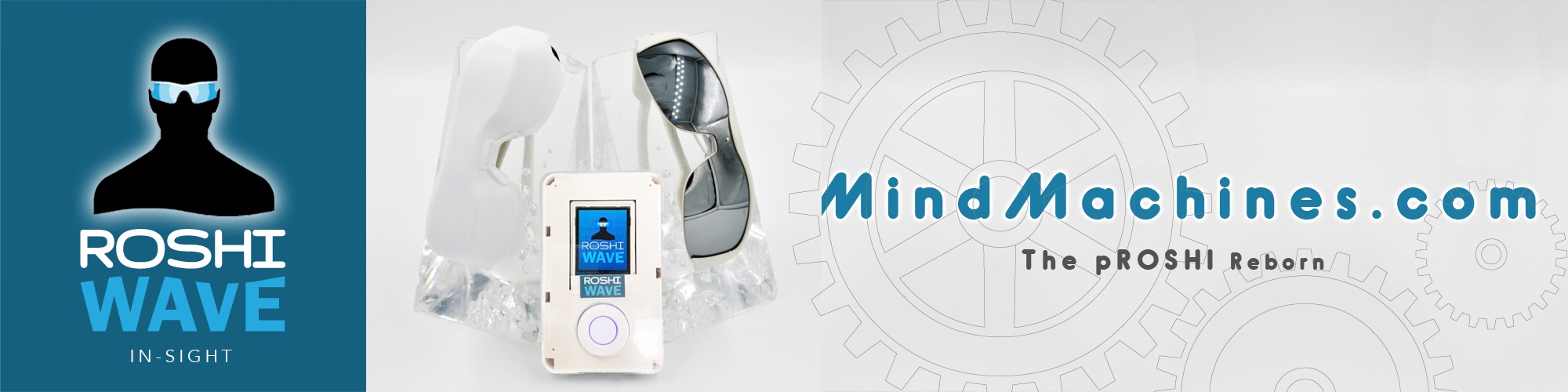
We are excited at MindMachines.com to be offering the pROSHI (personal ROSHI) photostimulation disentrainment device. The pROSHI is unique in the world of mind machines and is nothing like a typical light and sound machine. In fact, it is NOT a light and sound machine at all. The pROSHI is a Neurodynamic Activator™ and is in a class all its own. Standard light and sound machines run preprogrammed patterns of sound and light at specifc frequencies or frequency ranges to elicit the Frequency Following Response (FFR) in order to achieve a desired brainwave state. The pROSHI approach is radically different…

pROSHI Neurofeedback device

pROSHI

From the pROSHI manufacturer:
“By sending specially calibrated flickering light through the eyes and into the brain, pROSHI In-Sight Glasses help “DisEntrain” the mind, freeing it from its unhealthy cyclical patterns. The brain attain a meditative “normalized” state in which it becomes totally at rest …yet attentive at the same time—similar to the brain of a Zen Master. This helps put you “In the Zone”—whether you are an Athlete, Businessperson, Doctor, Bricklayer or simply a human being trying to cope with the pains and stresses of life.

pROSHI and Glasses

pROSHI and Glasses

The longer technical term for the above process is Vector Equilibrium Error DisEntrainment Photostimulation (VEEDP). Here’s how it works: The lights in pROSHI In-Sight glasses create an LED and MagStim flicker, driven by a Dynamic Vector Equilibruim algorithm, contained within the NeuroDynamic Activator®. This presents the brain with a complex set of phase instructions that it must accurately follow, in order to correct its own internal phase vector errors—true linear to non-linear transformation, in real-time. It is with this unique method that the brain performs its own neurofeedback duties, without any outside human intervention.

A decrease in dynamic phase error is the result. And that is exactly the outcome we seek. It is in these “quieter” EEG moments that the brain “corrects” itself. This Dynamic Self Organization (DSO) is the hallmark of NeuroFeedback systems, and will be at the vanguard of self-healing in future. “

pROSHI Glasses

pROSHI Glasses

I would describe the pROSHI as a visual “digital mantra” generator. A mantra is a phrase that is repeated by the meditator during meditation. It is not a recorded phrase played over and over, but rather repeated by the user over and over which means there are slight variations upon each utterance of the mantra. Unlike any other electronic device the pROSHI successfully emulates this tact. The pROSHI does not simply playback a specific session, rather it runs a program that creates a digital artificial visual mantra that contains organic variations. It is a “one-trick-pony” for sure, but it is one heck of a trick! That is the biggest strength of the pROSHI. It does one thing and does it very well. Rather than focusing on many mind states like a light and sound machine does, the pROSHI creates a deep meditative state ONLY and it does it quickly and easily. The second strength of the pROSHI is the SIMPLICITY FACTOR. It is an extremely simple device to use. There are only 3 very easy steps to follow to use it!

1.) Put on the glasses
2.) Turn on the power
3.) Close your eyes and adjust the brightness

pROSHI

Chuck Davis - Inventor of pROSHI

I have to admit upon first inspecting the machine I was skeptical because of the lack of sessions, sound, buttons and display screen. But after only a few minutes of using the device I was very impressed. The pROSHI is the fastest and easiest way to enter the “no time state” I have ever experienced. The “no-time state” is characterized by a lack of awareness of the passing of time. For example, what seemed like only 5 minutes was actually an hour or vice versa. I can tell you that when making note of the time before getting using the pROSHI my guess of how much time has passed when I take it off has always been wrong.

This is a pretty serious accomplishment for a mind machine.


  • If you are interested in experiencing a state of deep meditation – in very short order – then the pROSHI is for you.
  • If you desire to experience timelessness and “the no-time state of mind” – the pROSHI is what you need.
  • If you want the most simple mind machine that there is for achieving a deep meditatative state with no effort – get the pROSHI.
  • If you want one of the most powerful Neurofeedback devices that is used by professional clinicians worldwide – you guessed it, the pROSHI.

In addition to a variety of light glasses the pROSHI also includes a pair of MAGSTIM (electromagnetic stimulation) glasses. Look for a new post at mindmachines.com by me that goes in-depth regarding them in the future.

The pROSH can support either 2 users at once (with independent brightness control for each user) or 1 pair of light glasses + 1 pair of MAGSTIM glasses!

Previously pROSHI has only been available for use and sale from clinicians.  MindMachines.com is proud to offer the pROSHI Neurodynamic activator!

You can order the pROSHI here: pROSHI Neurodynamic Activator

EEG Neurofeedback or Mind Machines – Which is Right for You?

EEG Neurofeedback

EEG Neurofeedback is the voluntary regulation of brain wave activity. It is a learned response, with applications including the modulation of arousal levels, regulating your sleep/wake cycles, dealing with cognitive processes, processing sensory information, correcting inappropriate motor responses, controlling moods and emotions and helping deal with memory issues.

EEG Neurofeedback

EEG Neurofeedback

Here are two main applications within the EEG neurofeedback discipline: the first is Alpha and Theta training, which centers on relaxation and improved creativity. New research also indicates these EEG protocols can deal with overcoming the effects of alcoholism. The second application deals with Sensorimotor Rhythm (SMR) and Beta training. These protocols are generally aimed at improving mental functioning and the remediation of manifest deficits, such as for symptoms of epileptic and ADHD behaviors.

Those 2 paragraphs were my initial introduction to what EEG neurofeedback could accomplish. That was back in 1992. Since then a plethora of information has been published that gives credence to the successes of applying EEG neurofeedback in a multitude of ways (refer to issues of the AVS Journal).

But allow me to backtrack a bit.

I must give credit to Drs. Siegfried Othmer and Jerry Cunningham for making me aware of EEG technology and allowing me to learn about utilizing their equipment. Yes that was quite a few years ago, but their generosity sparked my interest in this young, yet exciting new field. Truth be told, I felt like a lab animal for those first 3 ten-hour days of instruction, as I soon realized when they uttered the words ?I wonder if?? meant I was the target of their thoughts. Thankfully, those two pioneers in this field were medical professionals and used protocols that when connected to the EEG neurofeedback system, made me feel more like a little kid at an amusement park, I could feel/sense my mental, emotional and physical states reacting in a different, more positive way.

Given time, I actually felt like I was contributing to their conversations rather than being the one person always hooked up to their EEG system ?to see what happens?. Either way I didn?t really care. On the one hand I was listening to 2 very respected professionals and on the other was able to experience sensations I?d never realized was possible.

One day we were comparing EEG protocols when the topic of adding adjunctive modalities into EEG neurofeedback sessions came up, with the goal of helping their clients achieve more quickly the targeted brainwave frequency of a session, theoretically enabling the client to proceed in their progress faster than normally believed.

This led to incorporating EEG Spectrum?s EEG Neurofeedback System with light and sound mindmachines, sound-only generators, an audio/visual mixer and the Symmetron motion platform (complete with 7-degree front/back pitch, 360-degree orbital movement and two transducers beneath the mattress for binaural beat tactile stimulation.

Once everything was connected, we were ready to do some serious brainwave research, or in my case, observing how we could enhance the effectiveness of EEG Neurofeedback sessions. One element was missing. For Alpha ? Training, closed-eye lightframes worked wonders. But a different type of lightframe was needed for SMR training. The solution was developing an open-eye style lightframe. I credit Jeff Labno for coming up with that idea. The result? EEG Neurofeedback became an all-encompass method for positive brain wave training. The proof was seeing the therapist?s monitor: increased entrainment ability emanating from the readout of the client?s brainwaves.

One hurdle remained, however. For prolonged EEG neurofeedback sessions, a different form of audio stimulus was needed. The mind is capable of foretelling what frequencies are going to be coming, which could lead to a loss of interest and decrease the effects of entrainment. Sine waves: boring. Binaural beats: decent but limited in design. Dual independent binaural beats: perfect. The human mind needs more than a single tone to remain entrained for a prolonged period of time. Binaural beats work, but are limited in designing entraining frequencies. Dual independent binaural beats are quite different. By using 4 distinct frequencies in a variety of ways, the mind maintains prolonged interest, with the effect of remaining entrained by the stimulation and thereby receiving a greater quality session. The result? You progress with your training faster.

EEG Neurofeedback is an excellent modality for treating symptoms sans pharmaceutical medications, and more. And there are highly qualified medical professionals that are making great strides in this field. Drs. Tom Collura and Rayma Ditson-Sommer to name two. Not to be different or aggravate professionals that I have the utmost respect for, but I have found implementing EEG Neurofeedback in a different way better suits my approach.

After performing several hundred hours of EEG Neurofeedback sessions on clients (and here I must add that Dr. Jerry Cunningham was my supervisor), I began to observe certain tendencies during the EEG sessions. For example, if the audio stimulation being used was generated in a synchronized manner, the client?s ability to achieve the targeted brainwave frequency was enhanced, and when given alternating pulsed stimulus, the ability to achieve the target frequency was inhibited. Humm? There were plenty of other tendencies happening, but this one intrigued me the most.

So EEG Neurofeedback sessions show the therapist just what is occurring in particular parts of their client?s mind. That?s a good thing. But the amount of sessions needed before any improvement can be observed with their client(s) can often exceed over twenty appointments. Given the cost of just one session means multiple sessions can be rather expensive. That?s really not a good thing.

As mentioned earlier, many strides have taken place in the field of EEG Neurofeedback. Better instruments, more sensitive readouts, remote use of EEG units, and hopefully you are sitting down for this: some insurance companies actually cover EEG Neurofeedback treatment.

EEG or Mind Machines

EEG or Mind Machines?

But for me, personally, after years of utilizing EEG Neurofeedback, light and sound mind machines, tactile stimulation and various other modalities, I find EEG treatment to be unnecessarily costly and downright slow in rectifying mental, emotional and physical ailments. I prefer specially designed sessions built into light and sound mindmachines. They are better accepted by my customers and clients as these machines cost far less than EEG equipment, can be used almost everywhere at your own convenience, with goals being met far faster than a multitude of EEG sessions. And consider this: for the price you pay a therapist to conduct your 20 or more EEG sessions, you can purchase your own EEG system, with training! For an effective mind machine that would meet your specific needs, they range in price from $200 to $600. For the correct EEG neurofeedback system, far more. Big difference!

But EEG sessions showed me several idiosyncrasies that assisted in making light and sound mindmachines produce more effective sessions. That ?in sync / alternating stimulus? observation was just one.

Today, I find the best use for my EEG system is to function as a form of real-time documentation of how effective and entraining a mindmachine session actually is. When I test a light/sound session and view it on the EEG monitor, I get an actual idea of how entraining a mindmachine session is, or isn?t. If the EEG readout illustrates the session?s entrainment qualities, that session is a keeper. If the readout shows very little entrainment ability, then the session is deleted. In short, for me, nothing beats an EEG neurofeedback system for documenting the effectiveness of a light and sound mindmachine session.

Copyright Mindmachines.com / Granada Hills, CA / Nov. 18, 2011  All Rights Reserved

show
 
close
Best deal on David Delight Pro with CES http://t.co/yCwN099y The ultimate light and sound mind machine with built in CES!